Case Study
Crossfill
Built and scaled AI-powered analytics and content optimization pipelines, improving data reliability, automation, and decision-making for commerce teams.
Screenshots
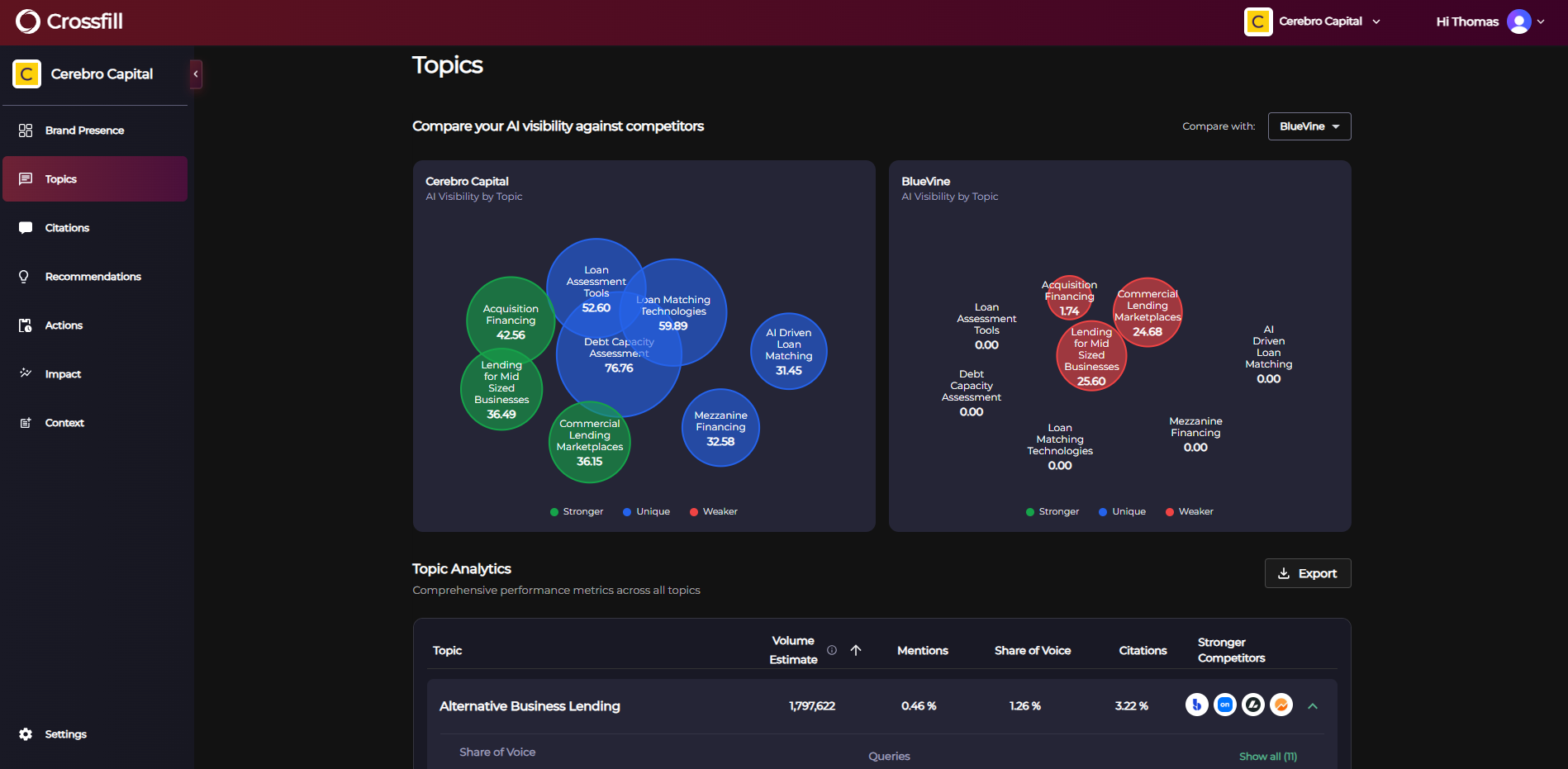
Crossfill topics insights overview
Crossfill
Senior Software Engineer
AI-powered analytics and content optimization platform for modern commerce teams
Joined as the 3rd engineer and helped shape the technical foundation of the product. Focused on building scalable data pipelines, AI-driven workflows, and reliable multi-tenant infrastructure to support fast-growing analytics use cases.
Key Outcomes
- Strengthened analytics and measurement pipeline for high-volume data workflows.
- Built content optimization pipeline powered by AI and workflow orchestration.
- Reduced latency and improved trust in reporting and insights.
- Enabled self-serve product capabilities with integrated billing and automation.
- Mentored engineers and contributed to a strong product-engineering culture.
Client
Crossfill builds tools that help commerce teams move faster by turning fragmented data into actionable insights.
The challenge wasn’t just aggregating data — it was:
- making it reliable
- making it fast
- and making it actionable through automation and AI
I worked on building systems that made this possible at scale.
Contributions
My work focused on analytics infrastructure, AI workflows, and platform scalability.
1. Analytics & Measurement Pipeline
I strengthened the core data pipeline responsible for ingesting, processing, and serving analytics.
- Improved reliability and consistency across reporting workflows.
- Reduced latency in high-volume data processing.
- Integrated external data sources (GA4, SEMrush) into a unified measurement pipeline.
- Built foundations for more trustworthy and explainable metrics.
2. Content Optimization Pipeline (AI-powered)
I developed a pipeline that automated content optimization using AI and external signals.
- Designed workflows to generate, optimize, and evaluate content performance.
- Integrated AI providers (ChatGPT, Gemini, Perplexity) into production workflows.
- Connected content outputs with analytics systems to close the feedback loop.
- Enabled continuous improvement of content based on real performance data.
3. Workflow Orchestration with Temporal
As complexity grew, I upgraded the system using Temporal for workflow orchestration.
- Replaced ad-hoc async logic with durable, observable workflows.
- Improved reliability for long-running and multi-step processes.
- Made failure handling, retries, and state transitions explicit and manageable.
- Enabled scalable orchestration for AI + analytics pipelines.
4. Integrations & Automation
I integrated key third-party systems to enable automation and self-serve capabilities:
- Stripe → self-serve billing and subscription workflows
- WordPress → automated publishing and performance tracking
- GA4 + SEMrush → analytics ingestion and measurement pipeline
This allowed the platform to move from manual workflows → fully automated pipelines.
5. Multi-Tenant Infrastructure & Security
I contributed to building a multi-tenant architecture designed for scale and isolation.
- Implemented tenant isolation using Cloud KMS + datastore patterns.
- Ensured secure handling of customer data across environments.
- Supported enterprise readiness through better data separation and access control.
6. Frontend & Product Layer
On the frontend, I worked with Next.js + TypeScript to build user-facing analytics and workflow interfaces.
- Built dashboards and interfaces for interacting with AI-driven insights.
- Used typed API contracts for strong frontend/backend alignment.
- Focused on clarity and usability for data-heavy workflows.
7. Mentorship & Team Impact
Beyond individual contributions:
- Mentored 2 engineers on system design, async workflows, and production readiness.
- Helped designers adopt a more iterative, “vibe coding” approach to building product experiences.
- Contributed to shaping engineering practices in an early-stage team.
Challenges
1. Scaling analytics pipelines
Handling large volumes of data while maintaining:
- low latency
- consistency
- and reliability
required careful design of async workflows and processing layers.
2. Orchestrating complex AI workflows
AI pipelines are inherently multi-step and failure-prone.
- Needed durable execution and retry mechanisms.
- Required clear observability into workflow state.
- Temporal helped, but required a shift in how workflows were modeled.
3. Closing the loop between data and action
Many analytics systems stop at dashboards.
The challenge here was:
- connecting insights → actions
- connecting actions → measurable outcomes
This required tight integration between analytics, content systems, and AI layers.
4. Multi-tenant system design
Supporting multiple customers required:
- strong isolation guarantees
- secure key management
- scalable data partitioning
Balancing these with performance and developer velocity was non-trivial.
Accomplishments
This project pushed me deeply into systems thinking, AI workflows, and scalable infrastructure.
- Built production-grade AI pipelines, not just prototypes.
- Gained strong experience in workflow orchestration (Temporal).
- Improved ability to design systems that balance flexibility, reliability, and scale.
- Contributed to a platform where data quality directly impacts business decisions.
Tech Stack
Frontend
- React / Next.js
- TypeScript
- MUI / ShadCN UI
Backend
- FastAPI (Python)
- PostgreSQL / SQLAlchemy
Infrastructure
- GCP
- Docker
- Kubernetes
Workflow Orchestration
- Temporal
Streaming / Realtime
- Server-Sent Events (SSE)
AI / Integrations
- OpenAI (ChatGPT)
- Google Gemini
- Perplexity
Data & Analytics
- Google Analytics (GA4)
- SEMrush
Platform & Auth
- Clerk (authentication)
- Stripe (billing)
What I’d Do Next
If I were to continue building this platform, I’d focus on:
- deeper personalization in AI-driven recommendations
- more autonomous optimization workflows
- better explainability in AI-generated insights
- stronger self-serve configuration for enterprise customers
The next step is evolving the system from analytics → autonomous decision-support platform.